
You open LinkedIn. You scroll past a post about someone losing their job. Then you see the comments.
"CFBR." "CFBR." "Commenting for reach."
It looks like a code. It feels like a robot invasion.
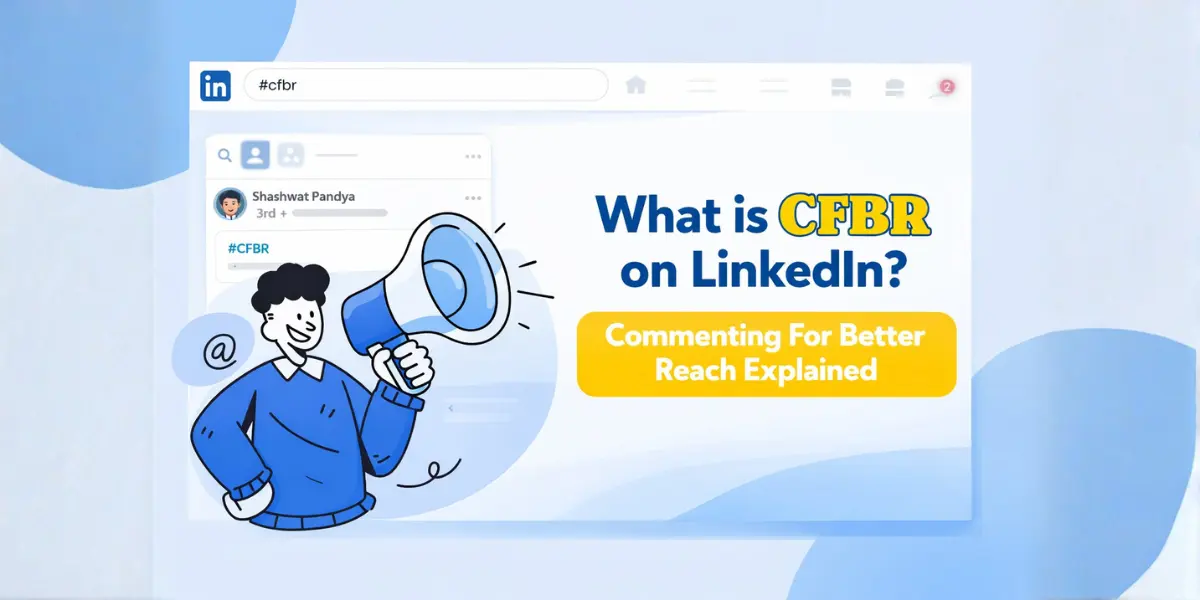
If you are wondering what CFBR means on LinkedIn, it stands for “Commenting for Better Reach.” People use it when they want their comment to support the visibility of a post.
But knowing the definition is the easy part. The real question is whether you should use it.
Most guides will tell you it is a great hack to boost visibility. They are half right. It boosts visibility for the post. It does very little for you. In fact, it might actually make you look lazy.
Here is the truth about CFBR. We will cover how it works, why people use it, and how to support your network without looking like a bot.
What Does CFBR Actually Mean?
CFBR is an acronym used in the comments section of LinkedIn posts. Users leave CFBR as a low-effort comment in the hope that the additional activity will help more people discover the post. LinkedIn does not recognise CFBR as a dedicated ranking command or signal.
The logic is straight forward. LinkedIn wants to show users engaging content. LinkedIn considers a broad mix of signals, including content relevance, freshness, professional context, viewing time and previous interactions such as reactions, comments and shares. The platform does not publish a universal rule saying comments always carry the most weight.
A comment can contribute to the activity around a post. However, further distribution depends on factors such as relevance to each viewer, the quality of the conversation, the viewer’s interests and their previous LinkedIn activity.
So, when someone types "CFBR," they are trying to manipulate the algorithm to give that specific post more visibility. Instead of relying on CFBR, focus on how to build meaningful LinkedIn connections with people who actually fit your goals.
CFBR became particularly visible on job-search, layoff and “Open to Work” posts during the early 2020s. Public posts show that the acronym was already in use in 2022, but there is no authoritative source establishing a single origin or proving that it began with the late-2022 technology layoffs.It has turned into something else entirely.
Common Variations You Will See
CFBR: Commenting For Better Reach.
Bump: A term borrowed from old internet forums to move a thread to the top.
Commenting for reach: The literal explanation.
The Dark Side: Are You in a Pod?
You cannot talk about CFBR without mentioning "Engagement Pods." These are groups of people, often strangers, who agree to comment on every single post a member publishes. The comment of choice? You guessed it: CFBR.
While this sounds like a clever way to beat the system, LinkedIn prohibits fake engagement, automated commenting and services designed to manipulate its content algorithms. Accounts using prohibited automation or fake-engagement tools may be restricted.
Repeated, coordinated or low-value engagement may reduce the authenticity of a conversation. However, LinkedIn does not publicly disclose a timing threshold or confirm that comments from the same group automatically reduce future post distribution.
On top of that, LinkedIn considers whether conversations are constructive and professional. Its published comment-ranking work has also considered the content of a comment, engagement around it and information about the commenter. This supports meaningful comments, but it does not prove that every short comment is automatically suppressed.
Why People Think CFBR Improves Reach
LinkedIn does not treat every comment as equally valuable in every context. A short comment still counts as an interaction, but LinkedIn also evaluates content relevance, conversation quality, viewer history and broader engagement patterns.
When you drop a "CFBR" on a post, two things happen:
Network effect: A comment may increase activity around the post and can make the commenter more visible through their activity.
Viral trigger: The post may also be recommended to relevant people inside or outside the author’s network. However, there is no guaranteed viral trigger because Feed distribution remains personalised.
This is why you see it so often on posts about layoffs or job searches. People want to help their friends get hired. They think typing an acronym is the fastest way to help.
They are not wrong. It is fast. But speed comes at a cost.
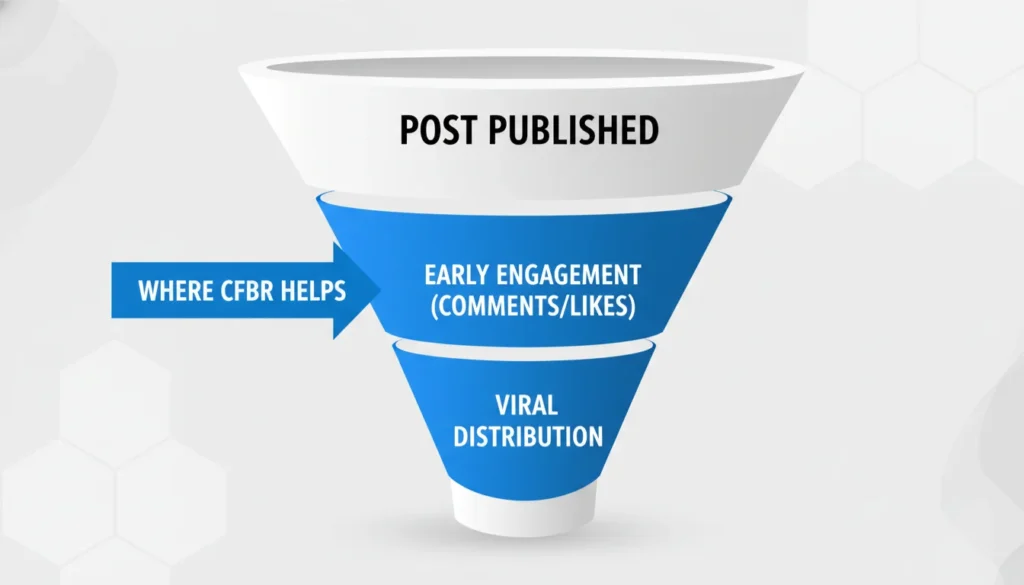
The Problem: Why CFBR Can Hurt Your Brand
Get Catalyzed focuses on storytelling and strong personal branding. From that perspective, typing "CFBR" is a wasted opportunity.
Imagine you are a recruiter or a potential client. You look at a candidate's activity feed. You see 20 comments in a row that just say "CFBR."
What is your impression?
This person has nothing valuable to say
This person is using a bot
This person is lazy
The "Lazy Support" Trap
Supporting a colleague who was laid off is noble. But typing an acronym is the bare minimum. It is like signing a birthday card with "Regards" and nothing else.
If you truly want to help someone, a meaningful comment works better. LinkedIn uses viewing time alongside active behaviours such as comments, reactions and shares. A useful comment can also encourage a genuine discussion, which may create more meaningful activity around the post. A specific comment invites replies. Replies create more comments. That is the real fuel for the algorithm.
The 24-Hour Experiment: Quality vs. Quantity
We wanted to see if the "lazy" approach actually saved time in the long run. We analyzed the performance of two different engagement strategies over a 24-hour period.
The Strategy:
Group A (The CFBR Route): Left 50 comments saying "CFBR" or "Commenting for reach" on trending posts. Time taken: 15 minutes.
Group B (The Value Route): Left 10 comments with at least 15 words, asking a specific question or sharing a personal insight. Time taken: 20 minutes.
The Results: To evaluate your own commenting strategy, compare two equivalent testing periods. Track comment visibility, replies, profile appearances, profile views and relevant connection requests. Keep the audience, account activity and posting frequency as consistent as possible. Treat results as directional rather than proof of how LinkedIn’s algorithm work from the original posters.
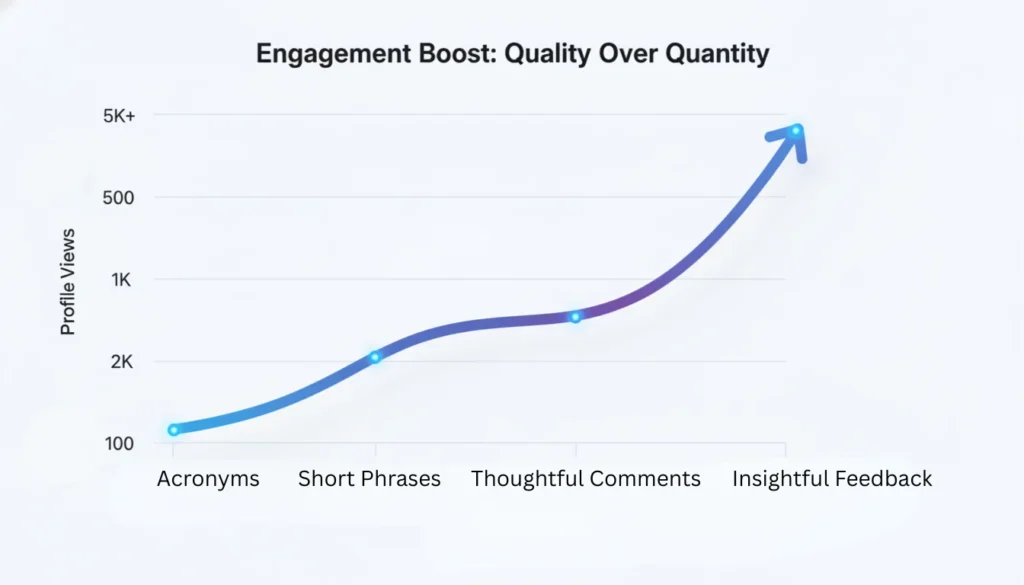
Why did this happen? It’s about space. A very short comment can disappear and be missed. A substantive comment can demonstrate expertise, provide context and give readers a reason to engage with the commenter. The goal should be relevance and usefulness, not occupying more screen space. If you want people to see you, you need to be visible.
What to Comment Instead of CFBR
You want to help your network. You also want to maintain a strong personal brand. You can do both.
Instead of typing "CFBR," write a sentence that adds value. This turns a generic interaction into a more useful LinkedIn engagement habit that supports your professional reputation.
Compare These Two Approaches
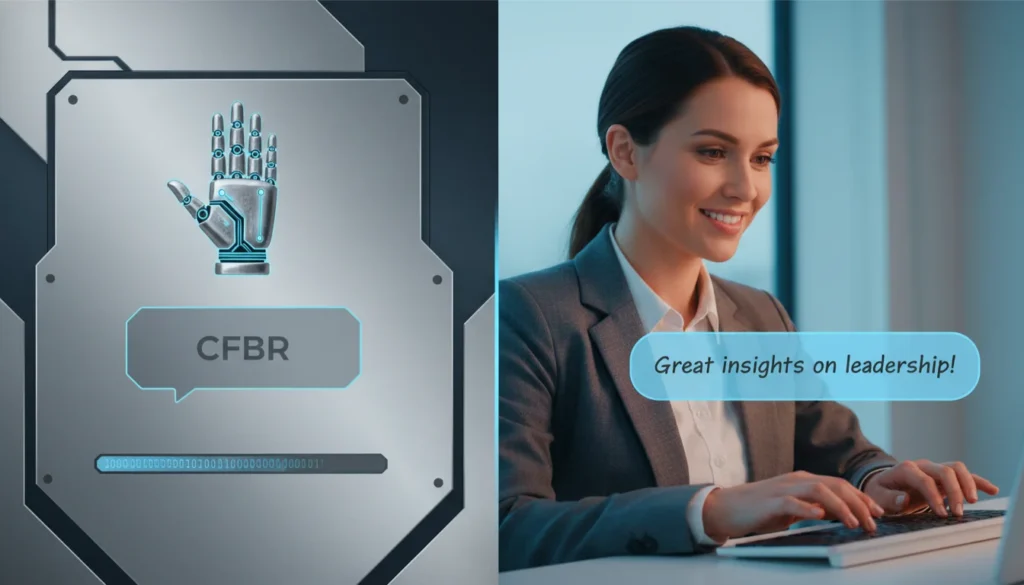
Option A: The Robot
Comment: "CFBR"
Result: The post gets a tiny bump. You look uninspired.
Option B: The Catalyst
Comment: "I worked with Sarah for two years. Her project management skills saved our Q4 launch. Any company would be lucky to have her leadership."
Result: The comment gives Sarah a credible endorsement, may encourage further discussion and helps the commenter demonstrate professional judgement.
When Is It Okay to Use CFBR?
There are moments when the acronym is acceptable. Context matters.
Urgent Calls for Help: CFBR may be understandable when someone wants to acknowledge an urgent community-support post and genuinely has nothing else to add.
Close Friends: In most cases, a short, specific comment, a direct introduction or a repost with context will provide more practical support.
Viral Chains: Sometimes a post explicitly asks for "CFBR" to beat the algorithm.
However, relying on it as your main networking strategy is a mistake.
Turn Visibility Into Opportunity
Let's say you start writing meaningful comments. You are helping others and getting seen by recruiters.
A better comment shows that you read the post and have something useful to add. If your comments bring profile visits, make sure you make your LinkedIn profile worth visiting.
They land on your profile. What do they see?
If your LinkedIn headline is vague and your banner does not communicate your positioning, visitors may leave without understanding what you do.
You need a solid foundation. A professionally optimised LinkedIn profile can improve the likelihood that relevant visitors understand your expertise and take the next step, such as following, connecting or contacting you. You want to convert that casual browser into a connection or a client.

Dwell Time Is One LinkedIn Feed Signal
There is a technical reason why the "Scripts" above work better than CFBR. It is called Dwell Time.
Engineers at LinkedIn have confirmed that the algorithm measures how much time a user spends looking at a post. LinkedIn uses time spent as one signal of relevance. Very short viewing can act as a negative signal, while longer viewing may indicate interest. However, LinkedIn uses adaptive models rather than one universal time threshold for every post and content format.
There is no verified minimum word count that automatically improves reach. Write enough to contribute a specific insight, experience, endorsement or question, but do not add words simply to satisfy an assumed algorithm rule
A thoughtful comment is usually more useful than CFBR because it contributes context, demonstrates expertise and creates a stronger foundation for conversation. It should be viewed as a relationship-building practice, not a guaranteed reach hack. By writing a thoughtful sentence, you genuinely help the algorithm, unlike those trying to trick it.
Summary: Stop Acronyms, Start Conversing
CFBR on LinkedIn simply means “Commenting for Better Reach.” The more important lesson is that meaningful engagement usually creates more professional value than repeating an acronym. The secret to using LinkedIn effectively lies in prioritizing meaningful conversations over algorithmic tricks.
But LinkedIn is a networking event, not a video game. You wouldn't walk into a conference room, shout "Visibility!" and walk out. You shouldn't do it online either.
Your Action Plan:
Stop auto-piloting with "CFBR."
Start Add a specific comment when you have something useful to contribute.
Audit your recent comments. Do you look like a human or a script?
If you are unsure if your current engagement strategy is actually building your brand, working with a LinkedIn personal branding consultant can help.
Audit your LinkedIn strategy with us and let's get you recognized for your expertise, not just your acronyms.