
A successful LinkedIn brand awareness campaign combines four things: clear positioning, a complete company page, credible founder or employee content, and paid distribution through formats such as Sponsored Content, video ads, or Thought Leader Ads.
To make this stronger, connect it with a clear LinkedIn B2B marketing strategy so awareness turns into pipeline, not just impressions.
Define one measurable goal, target an audience that is broad enough for efficient delivery, publish native content that creates recall, and review performance across reach, impressions, engagement quality, follower growth, branded search, and website demographics.
Brand awareness matters because most B2B buyers are not ready to buy today. LinkedIn's B2B Institute popularized the 95-5 rule, which explains that around 95% of potential buyers may be out of market at a given time. The exact split can vary by category, but the principle is useful: brand building helps future buyers remember you before they enter an active buying cycle.
That is what a LinkedIn brand awareness campaign is for. It is not the same as a lead generation push. It builds recognition, trust, and mental availability so that when a buyer, hiring team, investor, or partner is ready to evaluate options, your brand already feels familiar.
This guide walks through a practical 2026 framework for planning, launching, and measuring a LinkedIn brand awareness campaign. It covers organic content, employee advocacy, company pages, paid ad formats, audience sizing, budget testing, and a 90-day execution roadmap.
What Changed in LinkedIn Brand Awareness for 2026
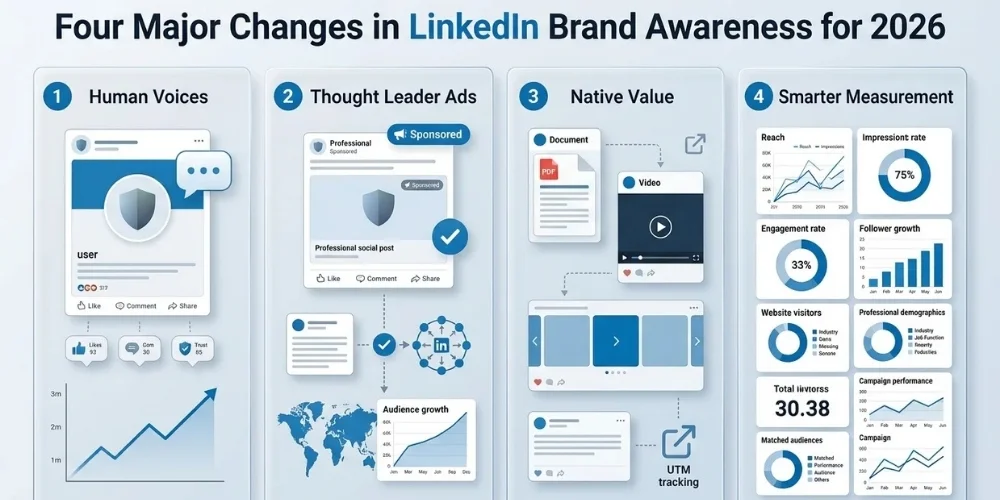
A few shifts matter enough that they should change how a campaign is built this year:
Human voices matter more in crowded feeds. Company pages are still important for credibility, but brand awareness is stronger when founders, leaders, and subject matter experts also share useful ideas from their own profiles. People often remember people before they remember logos.
Thought Leader Ads are now a key awareness format. LinkedIn allows eligible advertisers to sponsor and promote posts from company thought leaders. You can also build trust faster by combining paid campaigns with LinkedIn influencer marketing when the creator’s audience matches your target buyers.
Native value is safer than algorithm tricks. LinkedIn does not publish a universal rule saying every external link will be penalized. Still, awareness campaigns perform better when the main value is delivered natively inside the post, document, video, or carousel. Add links when traffic is the goal and track them with UTMs.
Measurement has become more precise. The LinkedIn Insight Tag, professional demographics, matched audiences, ad objective reporting, and Campaign Manager metrics help advertisers understand who is seeing, engaging with, and visiting from their campaigns.
The Brand Awareness Framework: 3 Channels Working Together
Think of LinkedIn brand awareness as three channels that each do a different job. The strongest campaigns use them together rather than treating LinkedIn as one isolated ad campaign.
Channel | Role | Why it matters |
|---|---|---|
Company Page | Credibility anchor | A complete LinkedIn Page with logo, cover image, description, website URL, and recent activity helps prospects verify that the business is real and active. If your page is not active or conversion-ready, improve your LinkedIn company page management setup before scaling paid visibility. LinkedIn states that complete Pages can receive up to 30% more weekly views. |
Personal Profiles | Trust and reach layer | Founders, executives, sales leaders, and subject matter experts can explain ideas in a more human way. Their posts can start conversations that a company page alone may not create. |
Paid Ads | Scale and precision | Campaign Manager lets you choose objectives, define professional audiences, control budgets, and amplify content beyond your current organic network. |
A practical campaign flow looks like this: a founder or team member posts a useful insight, the company page reinforces the message, and paid budget amplifies the strongest post to a wider but relevant audience. Sales and marketing can then review engagement and follow up where there is genuine intent.
Step 1: Define One Clear, Measurable Goal
Brand awareness sounds vague until you break it into a measurable outcome. Before you create a post or set your budget, answer these three simple questions.
Who exactly are you trying to reach? Define the job function, seniority, industry, company size, region, and buying role.
What single idea should they remember? Pick one association. A campaign that tries to say five things usually says nothing memorably.
How will you know it worked? Choose a primary metric before launch, such as reach, impressions, follower growth, branded search growth, video completion rate, or relevant website visitors.
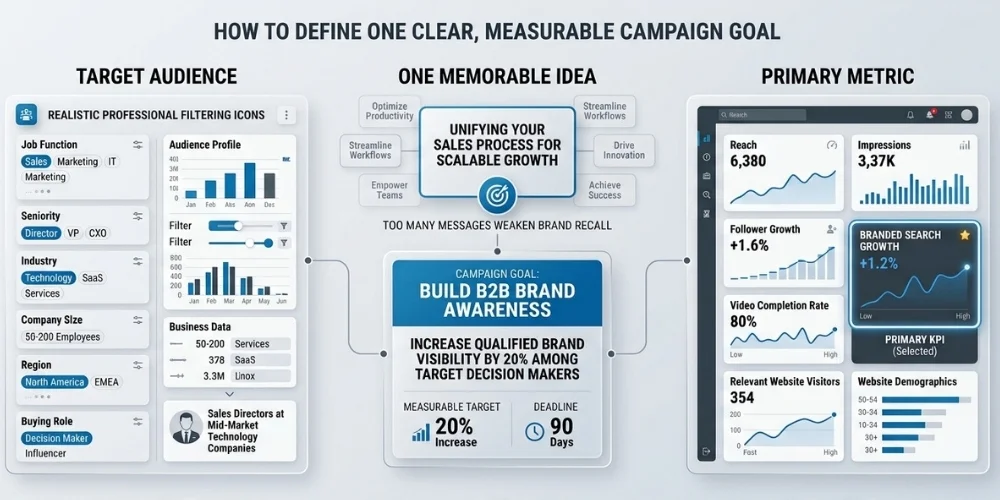
Example: A CRM automation company might set the goal as: "Become a recognized name for CRM automation among Sales Directors at mid-market technology companies." The campaign could measure progress through follower growth, video completion rate, website demographics, and branded search growth over a 90-day window.
Step 2: Target the Right Audience at the Right Size
LinkedIn's targeting can be very precise, but over-narrowing too early can make delivery expensive and limit learning. Build the audience in layers.
1. Start broad. Use location, industry, job function, seniority, and company size before stacking many narrow filters.
2. Use recommended scale for awareness. For Sponsored Content and Sponsored Messaging, LinkedIn suggests a minimum audience of 300,000 members for cost-effective reach. For Text Ads, LinkedIn suggests an audience between 60,000 and 400,000 members.
3. Use ABM differently. For account-based marketing, a smaller account list can work because the objective is depth with priority accounts, not broad market reach. Matched Audiences still need to meet LinkedIn minimum audience requirements before they can be used in an active ad set.
4. Let early data guide refinement. Run the campaign long enough to see which job functions, industries, company sizes, and seniority levels are engaging before narrowing further.
Approach | Best for | Recommended audience logic |
|---|---|---|
Broad awareness | Building recognition across an industry, role, or category | Use a broad but relevant audience. LinkedIn recommends at least 300,000 members for Sponsored Content and Sponsored Messaging. |
Text Ads awareness | Budget-conscious awareness and retargeting support | LinkedIn suggests targeting between 60,000 and 400,000 members. |
Account-based marketing | Reaching a defined list of high-value accounts | Use matched company or contact lists. Keep the audience large enough to meet LinkedIn minimum audience requirements after matching and location filters. |
If you are not sure which decision-makers to target, install the LinkedIn Insight Tag and review professional demographics from website visitors. This can show the job titles, seniority levels, functions, and industries already engaging with your website, which is a better starting point than guessing.
Step 3: Build Content Around Pillars, Not Random Posts
Random posting rarely builds recognition. A content pillar system gives the campaign a repeated shape people start to recognize.
Pillar | What it covers | Example post |
|---|---|---|
Education | Practical how-tos, frameworks, and mistakes your audience needs to understand | 3 mistakes that quietly weaken LinkedIn ad performance |
Perspective | A clear opinion, market insight, or contrarian view | Why impressions alone do not prove brand awareness is working |
Proof | Case studies, client results, benchmarks, and lessons from campaigns | How a B2B campaign improved qualified website visits over 90 days |
Human | Founder lessons, behind-the-scenes thinking, team moments, and operational learnings | What we changed after reviewing our first 100 LinkedIn ad leads |
Mix formats across these pillars: short text posts, native documents, carousels, polls, video, newsletters, and Thought Leader Ads. Video is worth testing for awareness and retargeting, but do not assume it will always be cheaper. Costs depend on the audience, bid strategy, objective, creative quality, and competition in the ad auction.
Step 4: Choose the Right Ad Objective and Format
The objective you select in Campaign Manager shapes the ad formats, bidding strategies, optimization goals, and reporting metrics available to you. Choose the objective based on the result you actually want, not just the label that sounds closest.
Objective | How to think about it | Best used for |
|---|---|---|
Brand Awareness | Optimizes toward reach or impressions. LinkedIn reports cost per result as total spend divided by every 1,000 member accounts reached. | Awareness campaigns where the priority is qualified reach. |
Website Visits | The key result is landing page clicks. Chargeable events can vary by optimization goal, bidding strategy, and ad format. | Campaigns where the main KPI is traffic to a website or landing page. |
Engagement | Designed to increase likes, comments, shares, follows, landing page clicks, and LinkedIn Page clicks. | Building engagement, social proof, and retargeting audiences. Monitor quality closely. |
Video Views | Optimizes delivery toward members likely to watch your video. | Building awareness, explaining a category, and creating video-based retargeting pools. |
Ad formats worth knowing for awareness
Thought Leader Ads: Promote an eligible organic post from a company thought leader or approved member. Use this when the message is stronger from a person than from a logo.
Sponsored Content: Native single image, carousel, document, or video ads in the LinkedIn feed. This is usually the core paid format for B2B awareness.
Text Ads: Lower-friction sidebar ads that can support awareness or retargeting, especially when budget is limited.
Dynamic Ads: Personalized ads that use member profile data. These are useful for recruitment, events, and follower growth campaigns.
Document Ads: Promote a native document such as a checklist, report, playbook, or framework. This can work well for educational awareness campaigns.
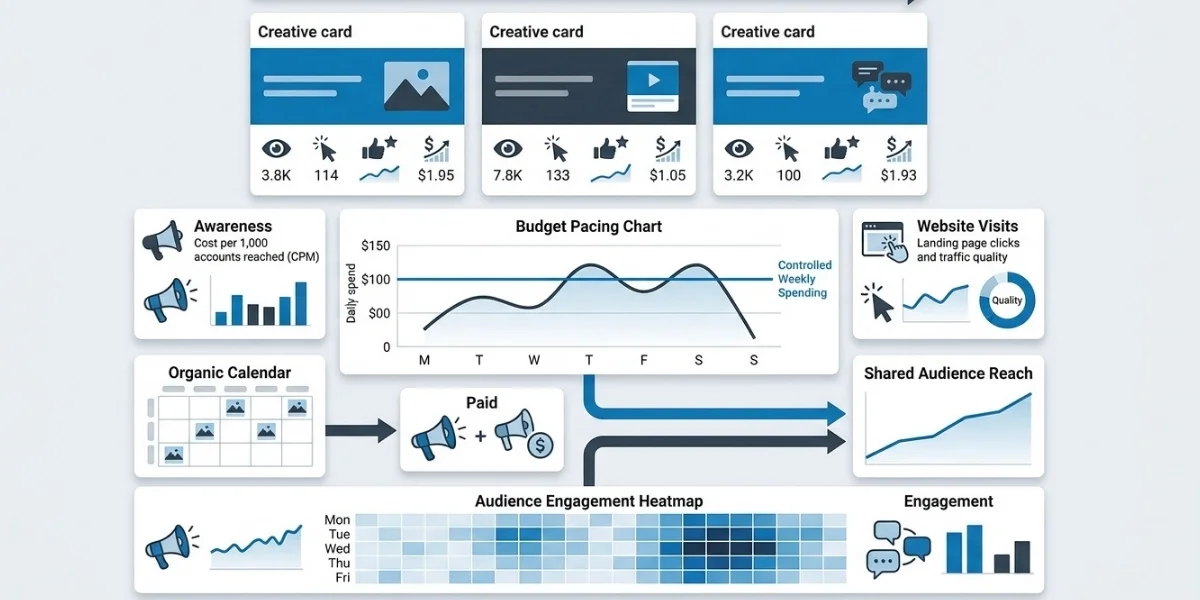
Step 5: Set a Budget and Schedule That Match Your Goal
LinkedIn ad costs are auction-based, so there is no universal 2026 CPC, CPM, video view cost, or sponsored message cost that applies to every advertiser. Budget should be set around learning first, then scaling what performs.
1. Test first. Run a two-to-four-week test across two or three creative variations before scaling. This gives you enough data to compare formats and audiences without committing too much spend too early.
2. Watch cost per result. For Brand Awareness ad sets, compare cost per 1,000 member accounts reached. For Website Visits, look at landing page clicks and traffic quality. For Engagement, separate useful engagement from low-intent reactions.
3. Understand budget pacing. LinkedIn says your daily spending may vary, but your campaign won't spend more than seven times your daily budget over one week.
4. Layer organic and paid activity. Consistent organic posting creates proof and messaging depth. Paid distribution adds controlled reach. The best campaigns use both.
5. Schedule based on data. Use your own audience analytics and Campaign Manager results to identify when your audience engages, rather than relying on generic best-time-to-post rules.
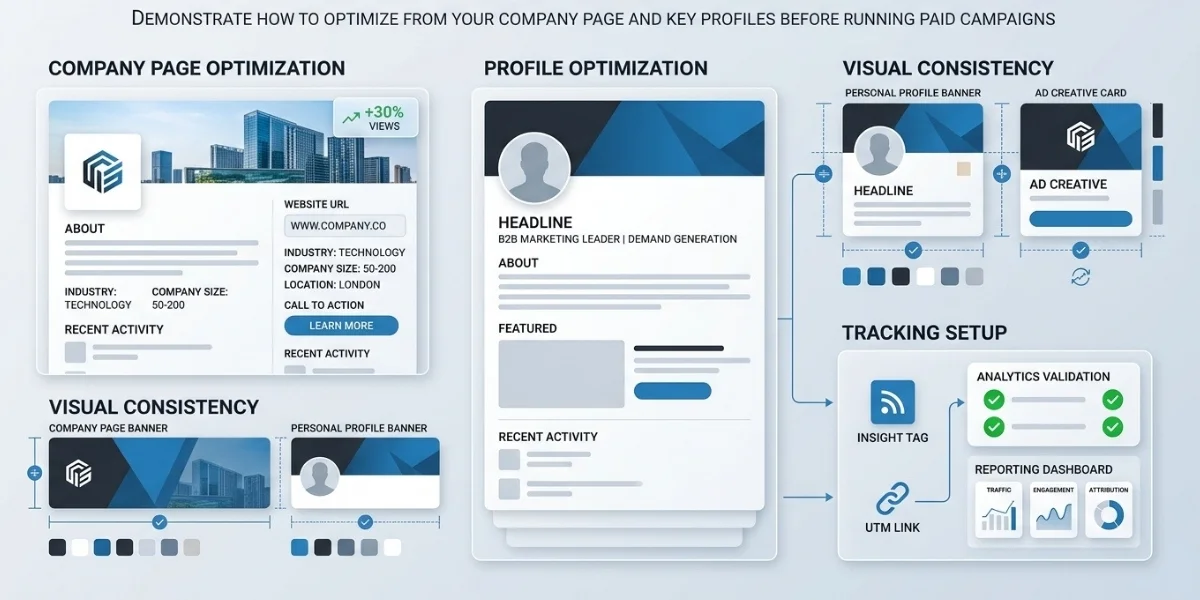
Step 6: Optimize Your Company Page and Profiles Before You Spend
Every paid campaign sends attention somewhere. If your company page and key employee profiles look incomplete, the campaign can create a weak first impression.
Company Page: Add a logo, cover image, clear About description, website URL, industry, company size, location, call to action, and recent activity. LinkedIn states that complete Pages can receive up to 30% more weekly views.
Employee and founder profiles: Update profile photos, banners, headlines, About sections, Featured sections, and recent activity before using a person as the face of the campaign.
Visual consistency: Use consistent colors, logo placement, tone, and visual direction across company page banners, ads, and personal profile banners tied to the campaign.
Tracking setup: Install the LinkedIn Insight Tag, use UTM parameters, and confirm that analytics are working before launch.
Step 7: Track the Metrics That Actually Reflect Awareness
Awareness metrics are different from conversion metrics. Judging a brand campaign only by immediate leads can make a good campaign look weak before the market has had time to recognize you.
Metric | What it tells you |
|---|---|
Impressions and reach | How often your content appeared and how many unique member accounts were reached. |
Cost per 1,000 reached | For Brand Awareness ad sets, this shows how efficiently the campaign is buying qualified reach. |
Engagement quality | Whether people are reacting, commenting, sharing, following, or clicking in ways that show relevance. |
Follower growth | Whether more people choose to keep seeing your brand after the campaign touchpoint. |
Branded search volume | Whether more people are searching your company name directly in Google Search Console or other search data. |
Website demographics | Whether website visitors match the audience you intended to reach. |
Retargeting audience growth | Whether the campaign is building useful audiences for later consideration and conversion campaigns. |
Set a baseline before launch. Compare results month over month rather than day over day because awareness compounds gradually.
A 90-Day LinkedIn Brand Awareness Roadmap
Phase | Focus |
|---|---|
Days 1 to 15 | Optimize the company page and key profiles. Install the Insight Tag. Define campaign goals, audience assumptions, content pillars, and baseline metrics. |
Days 16 to 30 | Publish organic content consistently. Test two or three paid creative variations with a controlled budget. Start with broad but relevant targeting. |
Days 31 to 60 | Review audience, creative, format, and cost-per-result data. Introduce Thought Leader Ads behind the strongest eligible organic posts. Adjust targeting based on engagement quality. |
Days 61 to 90 | Scale the best-performing formats. Compare results against baseline metrics. Build retargeting audiences for consideration or lead generation campaigns. Set goals for the next quarter. |
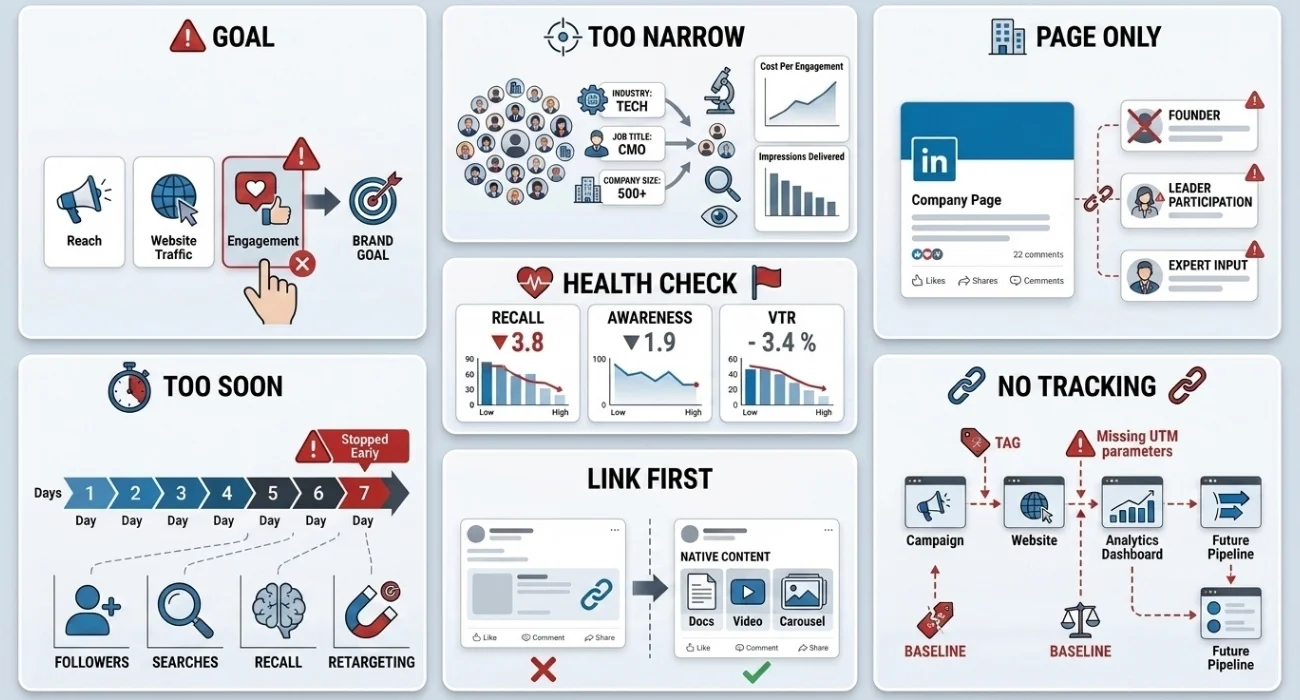
Common Mistakes That Quietly Sink LinkedIn Brand Campaigns
1. Choosing an ad objective by name alone
Brand Awareness is useful when reach is the priority. If the goal is website traffic, Website Visits may be more appropriate. If the goal is conversation or retargeting, Engagement may deserve a test.
2. Narrowing the audience too early
Stacking too many filters on day one can reduce delivery and increase costs. Start broad enough to learn, then narrow with evidence.
3. Relying only on the company page
Company pages carry credibility, but LinkedIn campaigns often need human voices from founders, leaders, and subject matter experts to create trust and discussion.
4. Judging results after one week
Awareness builds over time. A campaign that looks quiet after a few days may still be increasing recall, follower growth, branded search, or retargeting audience size.
5. Sending people away before delivering value
For awareness content, give the main insight natively first. Add links when they serve a clear traffic or conversion goal, and use UTM tracking so the data stays clean.
6. Skipping tracking setup
Without the Insight Tag, UTMs, and baseline metrics, it becomes difficult to tell whether awareness is improving the quality of traffic and future pipeline.
Conclusion: Build Recognition Before You Need It
A LinkedIn brand awareness campaign is not a single ad you launch and forget. It is a system of company credibility, human expertise, and paid amplification working together over weeks and months. If you want expert support with planning, targeting, and execution, explore our LinkedIn marketing services for business growth.
Define one clear goal. Start with a wider audience that matches your goals. Build content around repeatable pillars. Test the right ad formats. Keep the budget controlled until the data shows what to scale. Most importantly, measure awareness with metrics that reflect recognition, not only immediate conversions.
Done well, the payoff appears when a buying committee, investor, partner, or client already recognizes your name before the first sales conversation. That familiarity makes every later marketing and sales touchpoint work harder.